Uzbek Hospitality
Duration: 15 days/13 nights | Destination: Uzbekistan
Roksi Sam Travel invites you to discover new regions of Uzbekistan. We offer you lesser-known destinations that have preserved the charm and traditions of the past. With this goal, we have created this program off the beaten path. A new discovery, which we hope will excite you. The charm of these encounters will be emphasized by staying in a slightly rural family home, where your indulgence will be appreciated. However, your hosts will be happy to do everything possible to welcome you as guests.
Day 1 EUROPE – TASHKENT
Night flight.
Day 2 TASHKENT – URGENCH – KHIVA
Arrival in the morning. (Our services begin today).
Meeting with our Uzbek guide and breakfast at a teahouse.
Exploring the capital of Uzbekistan, an important place on the crossroads of the “Silk Road” and the “Golden Road” that came from Siberia. The Uzbek capital has managed to preserve its exotic atmosphere thanks to its open markets and parks with typical oasis vegetation.
Visit to the capital, the Museum of Decorative Arts, and the Torsu Bazaar.
Departure at 13:00 for Urgench, followed by a 30 km drive to Khiva, the most isolated of the Silk Road oases, still preserved. Accommodation in a guest house.
First walks in Itchan Kala.
Dinner at the Bir Gumbaz restaurant.
Day 3 KHIVA
Breakfast.
Then, exploring KHIVA, the ancient city of Turkestan, the capital of the 17th-century Khanate, located in the middle of the Khorezm oasis.
KHIVA was one of the largest markets in Central Asia, and its prosperity lasted until the beginning of the current century.
A real open-air museum, you will cross the maze of streets of ITCHAN KALA, a true fortified city almost 2 km long, entering through the western gates.
You will discover many madrasas (Muslim universities), mausoleums, and mosques, dominated by typical minarets:
The Muhammad Khan Ensemble from the mid-19th century. This madrasa is one of the largest in Central Asia and is now transformed into a hotel.
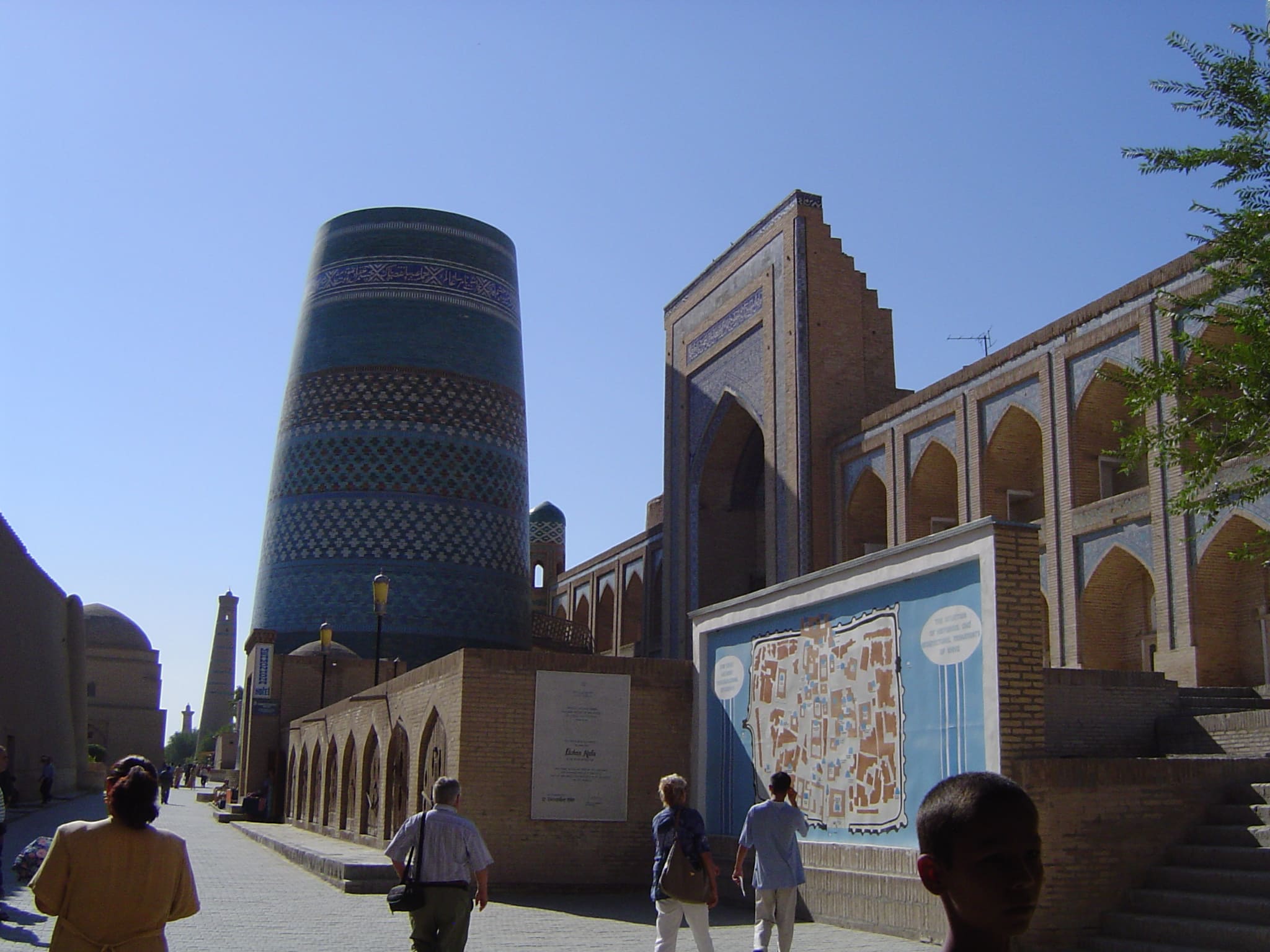
Kalta Minor, or the “Short Minaret,” the symbol of the city of KHIVA. This unfinished 30-meter-high minaret is made of green and blue majolica. It was intended to be the tallest minaret in all of Islam.
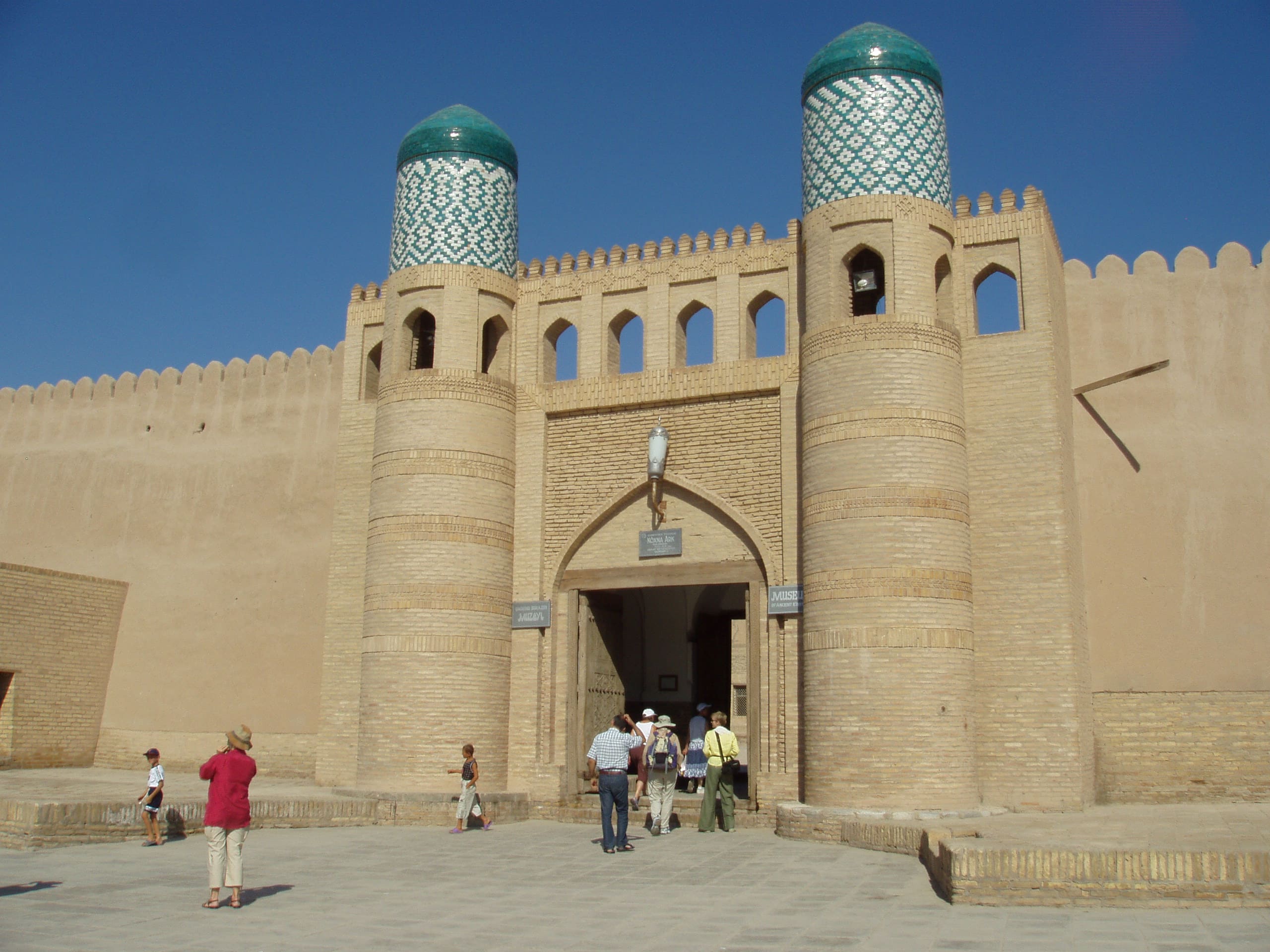
The Khunya Ark: This huge fortified castle, built in the 12th century, was a fortified palace for the Sultan. It was a city within a city.
Ak-Sheikh-Bobo Tower, the “White Sheikh’s Tower,” served as a watchtower. From here, you have a magnificent panoramic view of the entire city.
The Medrese Muhammad Rakhim
The Mausoleum of Said Alluddin, dating back to 1310. This mausoleum is the oldest monument in KHIVA.
The Juma Mosque or Friday Mosque. This mosque, intended for men, dates back to the 10th century and is no longer operational. Its uniqueness lies in the 213 carved wooden columns supporting the building, some of which date back to that period, while others were replaced.
Lunch in a traditional house.
Continued visits to:
The Islam-Khodja Minaret: Built in 1910, it resembles a lighthouse with turquoise and red stripes. It is the tallest minaret in the city, at 45 meters. This minaret served religious (calling to prayer), military (city defense), and navigation (for caravans) functions.
The Mausoleum of Pahlavon Muhammad: The city’s patron saint, this mausoleum is the most revered in the city and attracts many pilgrims. Its room is designed in Persian style, and the walls of the room containing the sarcophagus are decorated with stunning ceramics for the time.
The Caravanserai, now turned into an indoor bazaar.
The Toshshuli Palace: This palace was built as an alternative to the Khunya Ark. It houses the most luxurious interior of the city (faience, ceramics, carved wood, etc.), created by the best artists of that time. All visits in Khiva are done on foot.
Day 4 KHIVA – BUKHARA (470 km)
Early breakfast.
Departure to BUKHARA.
Following the banks of the Amu Darya River, flowing through the Kyzylkum Desert, you will reach the cotton plains reclaimed from the desert through irrigation with water from the Aral Sea.
Picnic lunch en route.
Arrival in BUKHARA, the “City-Museum,” which once had no fewer than 360 mosques before the revolution.
A true oasis in the middle of the red Kyzylkum desert, the city has preserved its Eastern spirit. BUKHARA, once known as the “Pearl of Islam,” is one of the most charming stages of your journey.
BUKHARA represents the essence of Central Asian architecture.
Check-in at the hotel.
Dinner.
Day 5 BUKHARA
Breakfast.
Departure to fully discover this fairytale city, which is home to luxurious monuments dating back almost ten centuries.
Ismail Samani Mausoleum: Located in a park, this is the oldest mausoleum in Central Asia (9th century). It is named after the founder of the Persian Empire. This mausoleum was built of baked brick, and its walls, almost 2 meters thick, have withstood the test of time. Depending on the time of day, it changes color under the sun’s rays.
The Work Source: The name comes from the well located inside. Legend has it that this mausoleum grants wishes if you circle it three times.
Bolo-Khaus Mosque and its magnificently decorated ceiling.
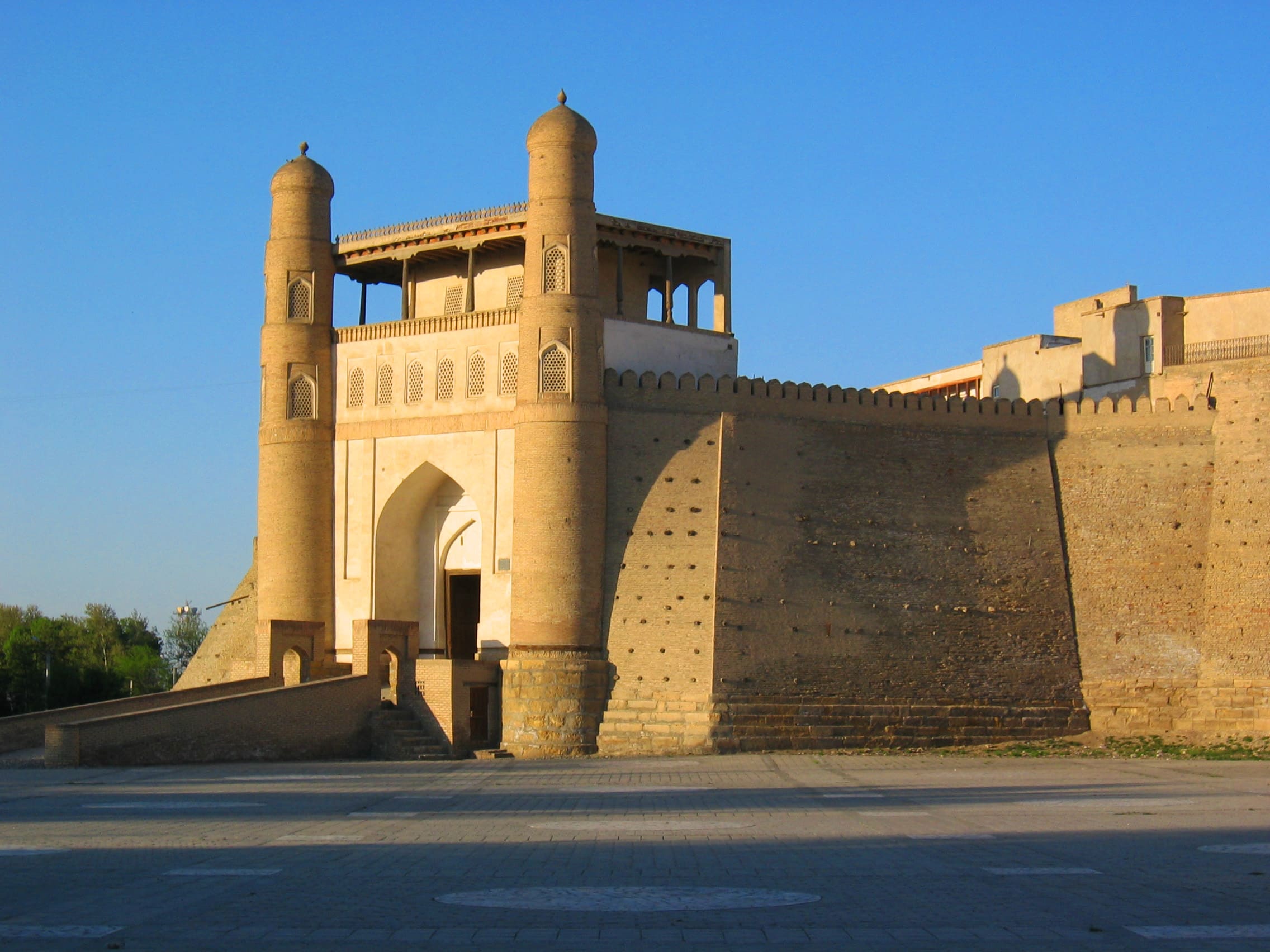
The Ark or Fortress: This ancient royal city was continuously occupied from the 5th century to 1920. Inside the Ark, 3,000 people lived, including the Emir and all his wives. From here, you have a wonderful view of the Registan Square, the main square of medieval BUKHARA and a privileged place for executions.
Poi-Kalon Square or “The Foot of the Great”: This is the most beautiful and monumental square in the city. Three impressive monuments are located here:
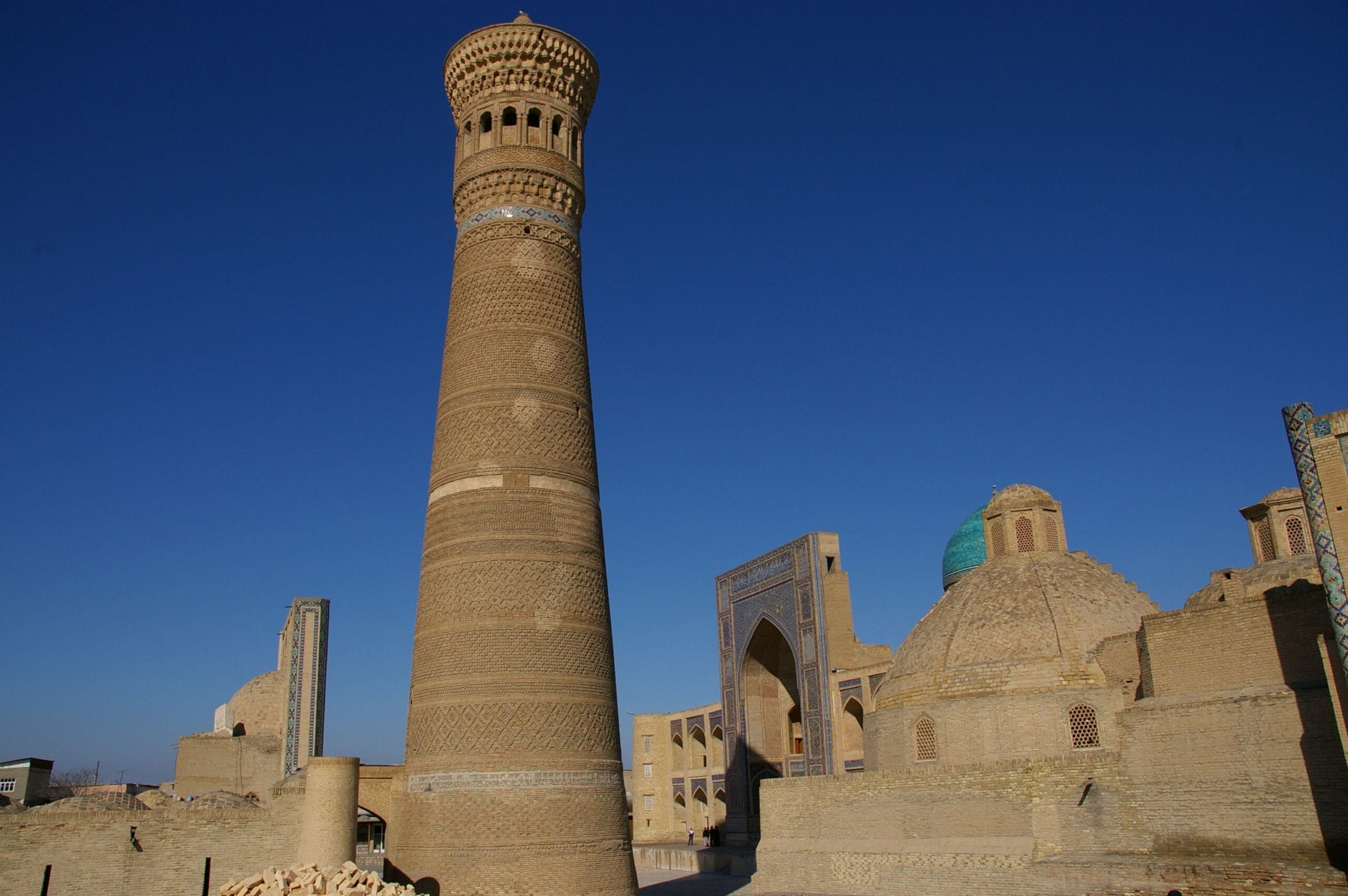
The Kalon Minaret, 48 meters tall.
The Kalon Mosque, of astronomical dimensions (130 meters long and 80 meters wide), which could accommodate up to 10,000 people at the time. It is no longer operational except for major religious holidays like Ramadan.
The Mir-i-Arab Madrasa: Still a functioning madrasa for boys, crowned with brightly colored blue domes that contrast with the surrounding brown. Lunch during the visit.
Continued visit:
Ulugh Beg Madrasa, decorated with blue faience.
Magoki Attari Mosque, 16th century.
La-Khanaka: Located near the Labi-Haouz pool, a place built in 1620 around a pond shaded by centuries-old mulberry trees. This place is the city’s green lungs and the most relaxing place in the city. In its heyday, there were about a hundred ponds here, and this is the only one that has survived.
Nadir Divanbegi Madrasa, originally designed as a caravanserai.
Kukeldash Madrasa, nearby: Once the largest Quran school in Central Asia.
All visits in Bukhara, as in Khiva, are done on foot.
Day 6 BUKHARA
Breakfast.
Morning excursion to visit the great pilgrimage site *Bahauddin Naqshbandi, where numerous Uzbek pilgrims from all over Uzbekistan come to venerate the tomb of the Sufi saint Naqshbandi.
The Sitorai-Mohi-Hossa Summer Palace, the summer residence of the last emirs of Bukhara.
Chor Minor Madrasa, original in its architectural style.
Visit to Maison de Souzani, the embroidery workshop of Mr. Rahmon Toshev.
Lunch “table d’hote.”
Free walk in the afternoon.
Folk concert at the madrasa.
Day 7 BUKHARA – GIDJDUVAN – YANGAZGAN (YURT CAMP)
After breakfast, departure to Yangikazagan.
On the way, stop at Gijduvan to visit the famous traditional pottery factory.
Continue towards Nurata. Visit this great oasis fed by Chashma, a source with virtues recognized in Uzbekistan, and its sacred fish.
We discover the ruins of Alexander the Great’s fortress in the shape of the Little Bear, the 14th-century Chiltan Ustun Mosque with 40 columns, the 16th-century Panzhwakhta Mosque (from 5 prayers), and the mausoleum of Sheikh Abdul Hasan Nuri (8th century).
Lunch with locals.
Arrival at the yurt camp and setup under a yurt.
Mehare in the desert (about an hour).
Outdoor dinner and singing Kazakh songs by the fire.
Overnight in a yurt.
Day 8: YANHIGAZGAN (YURTS) – AIDARKUL – SOB VILLAGE (130 KM)
After breakfast, departure to Lake Aidarkul for a walk and picnic by the lake.
Drive to Sob village, located in the Nuratau mountains (130 km). Arrival at a small village, hidden in the depths of a valley. We will be greeted by the hosts, who will offer us traditional “tea.” Accommodation in a private house. Visit to the local school. Dinner and overnight stay with our host, Kakor.
Day 9: Hike from SOB VILLAGE to SENTOB VILLAGE – Usum Village
Breakfast. Departure from the Sob valley, where we quickly leave the crops and gardens behind and reach a small pass (Nikarte), which opens into the Sentob valley, where the rocky landscape predominates. Descend toward Sentob village to join a trail leading to the village. We cross the village and stop for lunch with a local family.
After lunch, a short drive to Hayat village for accommodation with a local resident. Though the accommodation is in a rural style, the hospitality and gardens are charming. Afternoon walk around the area.
Day 10: HAYAT VILLAGE – ASHRAF VILLAGE – ESKI FORISH VILLAGE
Breakfast. Departure for a hike towards Eski Forish village (Old Paris). This area is protected to preserve its ecosystem, and depending on the season, we may enjoy the local flora and, if lucky, some wildlife.
Stop in Ashraf village for lunch at Shiringul’s house.
Continue the hike to Eski Forish village. Arrival and accommodation with local residents.
Day 11: Eski Forish – SAMARKAND (200 KM)
Drive to Samarkand after breakfast.
Arrival in Samarkand.
Lunch in a tea house.
The legendary city of the Silk Road, the capital of one of the greatest empires, Samarkand will leave no one indifferent.
In 1868, the city was successively occupied by the Greeks, Arabs, Mongols, and finally the Russians. First of all, Timur, the founder of a vast empire, whose capital was Samarkand, and his grandson Ulugh Beg, glorified the city.
From above, the domes and minarets catch the eye, and on the ground, the majestic and disproportionate monuments create undeniable magic.
Visit the ruins of Ulugh Beg’s giant observatory, which was used to calculate the position of stars, and the museum with magnificent frescoes discovered at the archaeological digs of Afrasiab, an ancient city destroyed by Genghis Khan.
Take a walk around the city of Afrasiab at sunset.
Dinner in a local restaurant.
Accommodation.
Day 12: SAMARKAND (200 KM)
Breakfast.
Continue the journey to the Shah-i-Zinda complex, the most mesmerizing place in the city.
This necropolis is an alley of tombs, each more beautiful than the last.
It is one of the oldest buildings in Samarkand and an important pilgrimage site. The tombs contain the remains of relatives and favorites of Timur and Ulugh Beg.
Rich majolica and mosaic facades will delight the eye and photographers.
To the northeast of Samarkand is the Bibi-Khanym Mosque, which must have been the largest in Central Asia. Only the portal, two small side buildings, and the large central mosque remain.
Visit the grand bazaar in Samarkand, the best sight in the city.
Lunch in the city.
In the afternoon, visit the Registan.
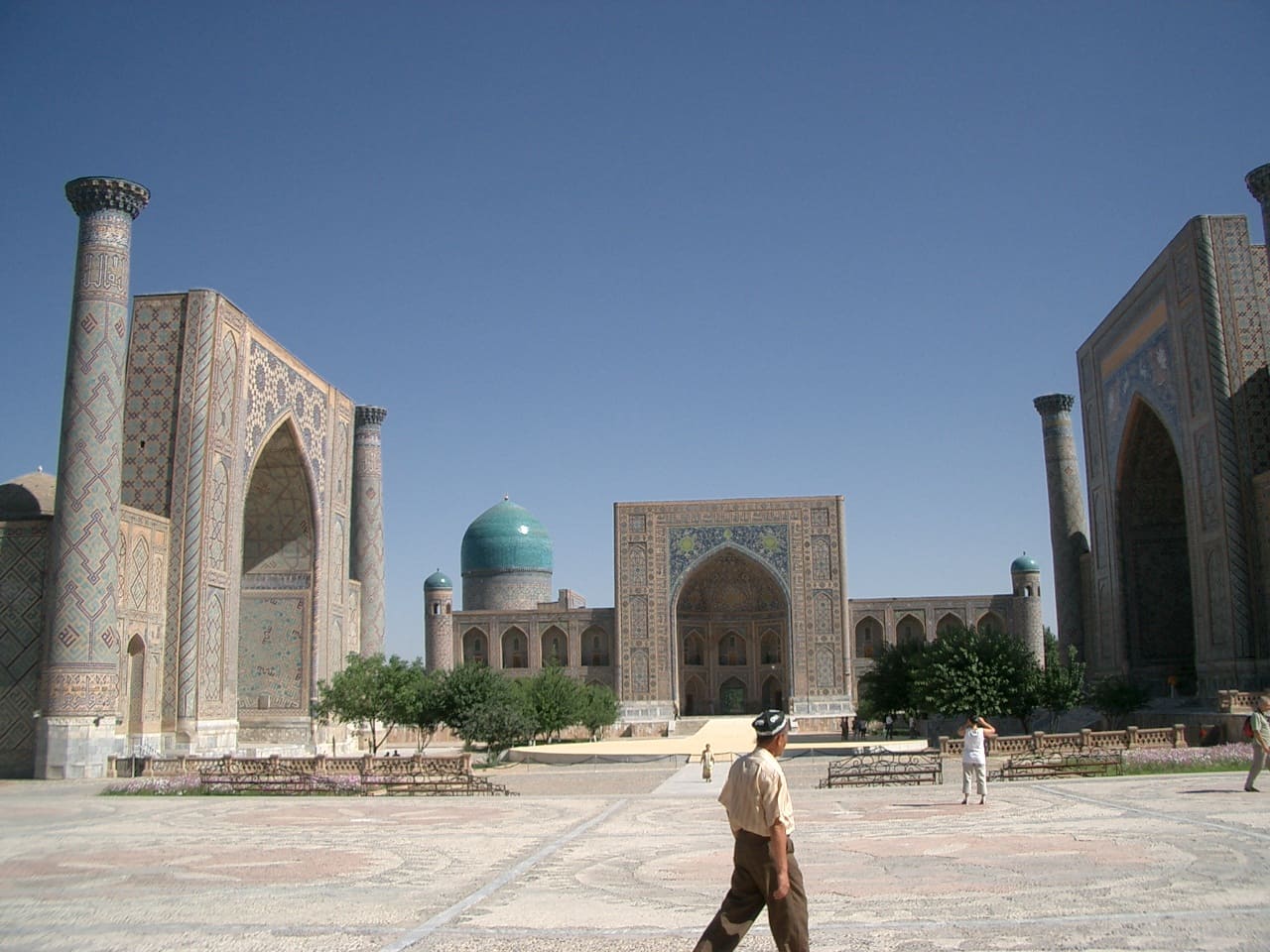
This collection of majestic, slightly slanted madrasahs, whose beautifully proportioned spaces are covered, almost excessively, in clayware and blue mosaics, is the central element of the city and perhaps the most impressive architectural structure in Central Asia.
On the west side is the Ulugh Beg Madrasah, the largest university in Central Asia.
Opposite, you will find the Sher-Dor Madrasah and Tilla-Kari Madrasah, built in 1636. The latter, due to its interior decoration, is aptly named “covered in gold.”
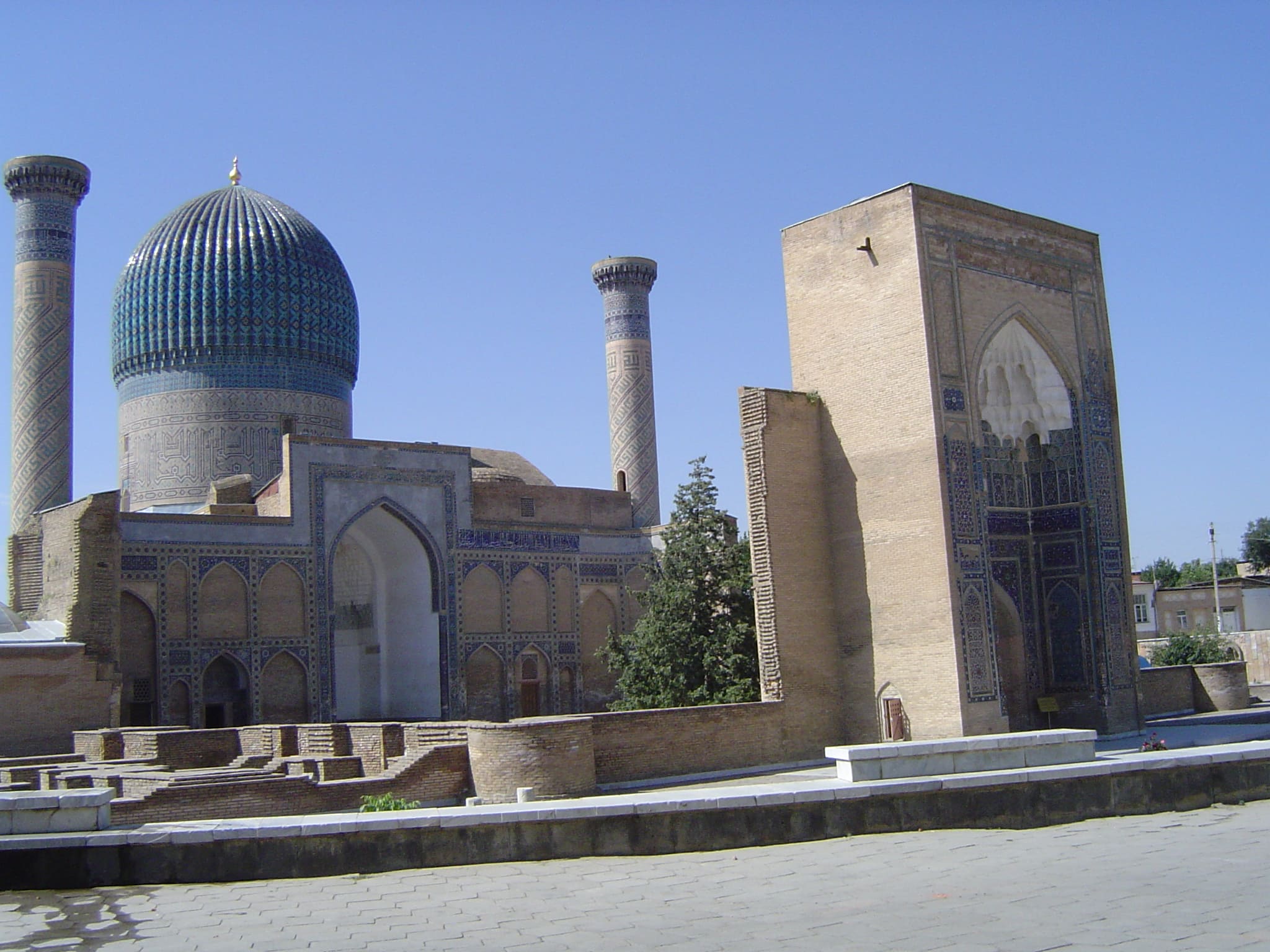
Continue the visit to the most famous monument in Samarkand, which is also the symbol of the city: the Gur-e-Amir, the distorted name “Guri-Mir” or “Tomb of the Emir.”
Like other Muslim mausoleums, the slabs simply mark the burial place in an underground crypt.
It is in this mausoleum that Timur, Ulugh Beg, and other members of his family are buried. The interior of this mausoleum is luxurious.
Dinner in a local restaurant.
Accommodation.
Day 13: SAMARKAND – SHAKHRISABZ – SAMARKAND (140 KM)
Breakfast.
Drive to Shakhrisabz, a city located at the foot of the Zeravshan mountains. This is the birthplace of Timur in 1336. Visit the ruins of Timur’s palace (Ak-Saray or White Palace), the Kok Gumbaz Mosque, Hazret Imam, and the tomb of Gumbazi Sayidana… Dinner in Shakhrisabz, then return in the afternoon. Drive back to Samarkand.
El-Merosi Show: A performance of traditional and historical costumes followed by dances and music.
Dinner and accommodation.
Day 14: SAMARKAND – TASHKENT by train (2 hours 20 minutes)
Breakfast.
Free morning in Samarkand for souvenir shopping and other goods.
Lunch at your own expense.
In the afternoon, transfer to the “Afrosiyob” train station for departure to Tashkent. Arrival at the hotel and farewell dinner.
Accommodation.
Day 15: TASHKENT – EUROPE
Breakfast.
Morning visit to:
Kukeldash Madrasah (16th century),
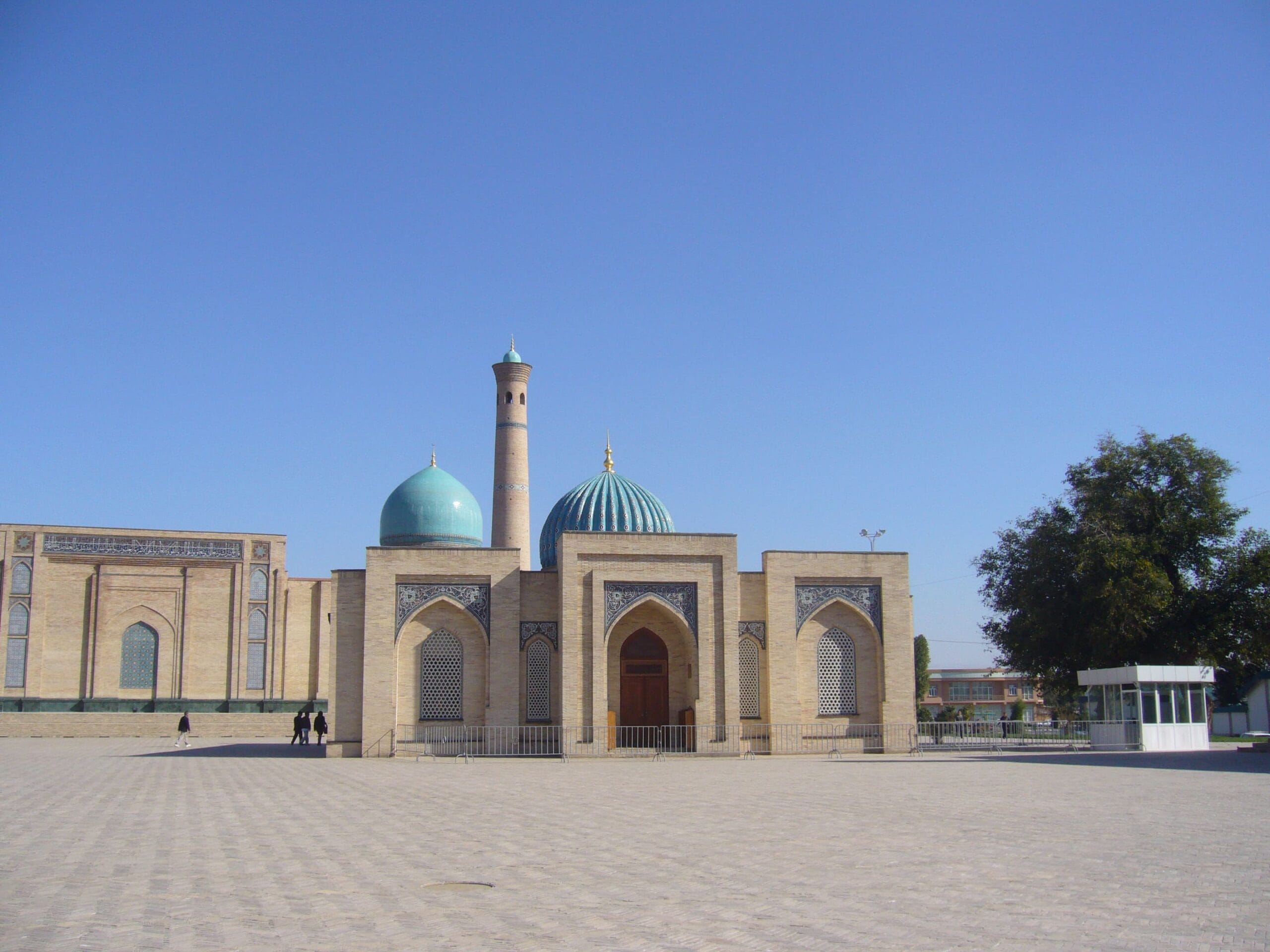
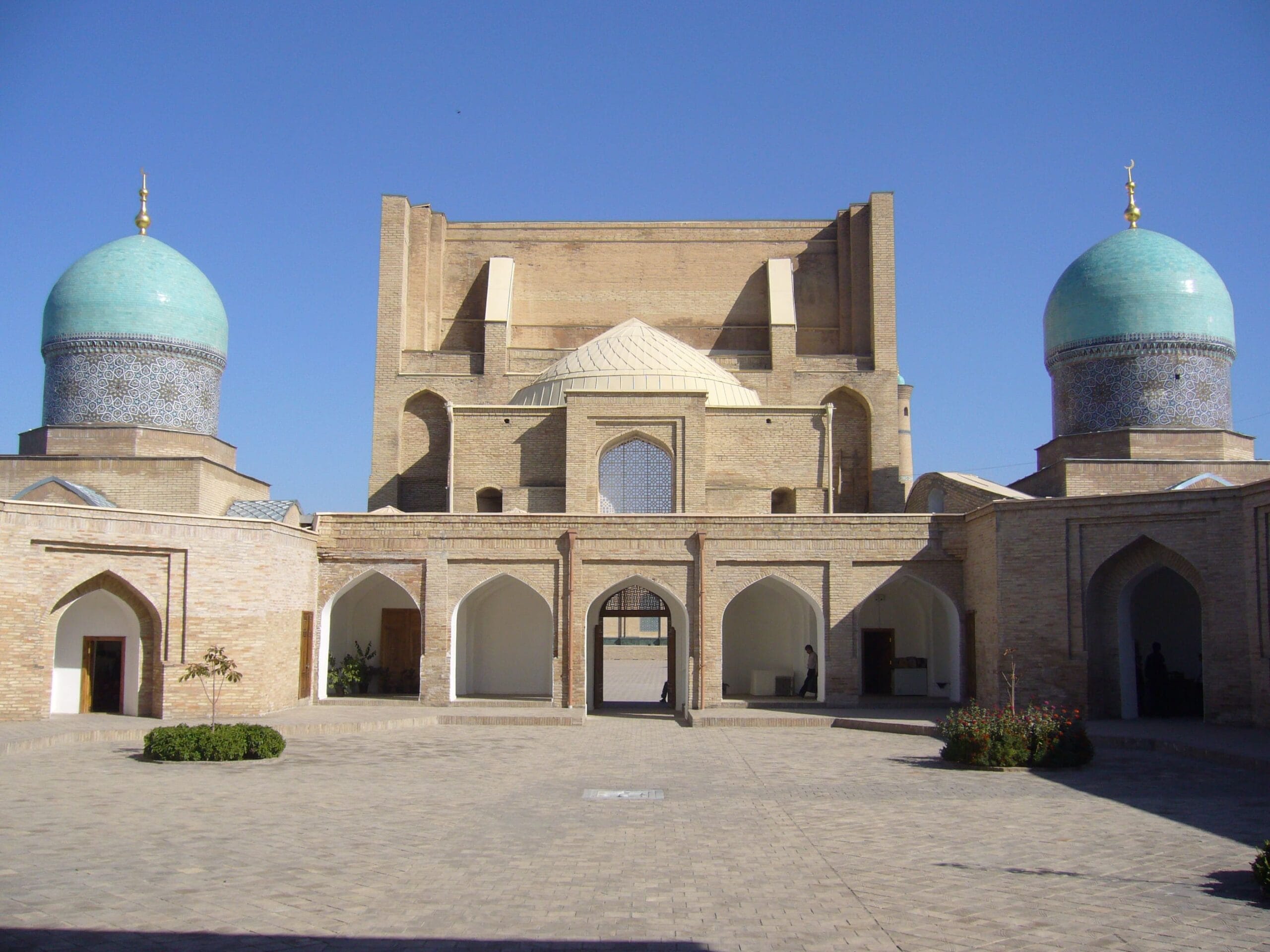
Khast Imam Complex: Barak Khan Madrasah (16th century), Tilla Sheikh Mosque (19th century), Kaffal Shashi Mausoleum (16th century).
Lunch in a tea house.
Transfer to the airport according to the departure flight schedule, and flight to Europe. End of our services.
Included in the cost:
Transport
Accommodation
Meals on Days: 8, 9, 10, 11
French-speaking guide
Train ticket from Khiva to Bukhara in a compartment (4 seats)
Fast train ticket from Afrosiyob, Samarkand – Tashkent in economy class
Mountain guide
Folklore concert in Bukhara
Entrance fees to museums and monuments listed in the program
El Merosi Theater in Samarkand
Not included in the cost:
International flight
Domestic flight Tashkent-Urgench (110 euros per ticket)
Supplement of 200 euros for a single room only in cities
Food, except as specifically mentioned
Insurance, permission to take photos and videos at sites
Tips for guides and drivers
Registration and Rules: Registration for this trip will be confirmed after written confirmation and the payment of a 30% deposit of the total trip amount by the participant. An invoice with the payment method will be sent to you by email once you accept the offer. The remaining amount must be paid one month before the departure date, without any reminder from us. If you register less than a month before departure, you will be asked to pay the full amount when accepting the offer.
Cancellation by the client: If you cancel (for any reason) more than 40 days before departure, the amounts paid as a deposit will be refunded, except for a fixed amount of 50 euros per person (application fee and bank charges).
After 40 days before departure, the following scale of deductions applies:
From 40 to 22 days: 25% of the trip cost
From 21 to 15 days: 50% of the trip cost
From 14 to 8 days: 75% of the trip cost
Less than 8 days: 100% of the trip cost
Please note: In the event of cancellation, please notify us as soon as possible by email or fax, as the date of receipt of the cancellation will be used to calculate the refund.
Any trip interrupted or shortened by the participant for any reason does not entitle them to a refund.
Cancellation by Roksi Sam Travel: Cancellation may occur due to circumstances beyond our control (political unrest, security issues, etc.). In such cases, cancellation will be made by Roksi Sam Travel in full, but no further compensation will be provided.

Your guide
to Central Asia
CONTACTS
- +998 78 210 02 09
- +998 66 234 98 64
- Email: roksisamtravel@mail.ru
- Samarkand city, st. Mirzo Ulugbek, 75